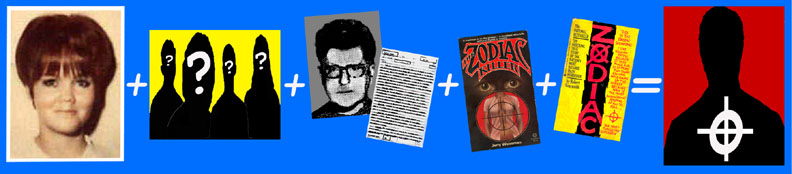
Zodiac Killer Painting Party

Darlene Ferrin, the Painting Party, and the Stalker

Listen to the author's audio webcast regarding the many myths surrounding the life and death of Zodiac victim Darlene Ferrin, ZODIAC: A to Z Part Four.

  • On the night of July 4, 1969, Darlene Ferrin and her friend Michael Mageau were both shot while sitting in a parked car at Blue Rock Springs Park in Vallejo, California. Darlene Ferrin died, but Michael Mageau survived to tell his story. He told police that the gunman had simply driven into the parking lot, exited his vehicle and then began firing a gun at Michael and Darlene. Later, the Zodiac claimed responsibility for the crime and police had little reason to doubt him. The evidence indicated that Darlene did not know her killer and was the victim of a random attack.

    Joseph Delouise, a well-known psychic, contacted Darlene’s mother. Convinced that police had failed to pursue the leads provided by Delouise and Darlene’s family, Delouise’s West Coast Representative Christopher Harris persuaded Vallejo Mayor Florence Douglas to attend a press conference in Los Angeles at the Statler Hilton Hotel. Douglas was a candidate struggling to win the Democratic nomination in the Governor’s race against incumbent Ronald Reagan. To her critics, the event seemed to be nothing more than the kind of grandstanding typical in an election year. “I believe some clues were overlooked in the murder of Darlene Ferrin,” Douglas told reporters. The campaigning mayor did not believe that Ferrin was the victim of a random act of violence but the deliberate target of a killer she may have known. Douglas denounced the Vallejo police investigation and called for a new examination of the case.

    Christopher Harris addressed the crowd and criticized the Vallejo police. “I observed while in Vallejo that the police disregarded the ridiculous,” he said. “I am now a firm believer that in the ridiculous, especially in the case of Darlene Ferrin, lies a storehouse of clues. The police should have done a complete character sketch of Darlene Ferrin. There are too many questions into her death that have not been properly tied down.” Harris was apparently unaware of the fact that police had thoroughly investigated any and all leads, including information provided by Darlene’s family.

    Harris also stunned reporters with a baffling revelation. During her visit with psychic Joseph Delouise, Darlene’s mother claimed that her daughter had exhibited her own ability to accurately predict the future. Mrs. Suennen told Delouise that Darlene had made a cryptic remark just hours before she died, “You might read about me in the papers tomorrow.” Darlene’s mother had not mentioned this potentially important information during any of her conversations with police, yet, according to Harris, she only shared this secret with a psychic months after the murder.

    The episode created a minor controversy, but the allegations regarding apathetic police and the mysterious secrets of Darlene Ferrin had a lasting impact.

    On May 5, 1977, Vallejo Police Lt. Jim Husted received a tip from a confidential informant regarding the Ferrin case. Husted’s report read, “Upon reviewing information submitted there seems to be sufficient cause to initiate an investigation to ascertain the validity of this information. Information consists of the following points which are only brief inquiries into the background of the alleged suspect. This information is viewed as circumstantial at best, but sufficient to require follow-up investigation.”

    The suspect, later named with the pseudonym “Andrew Todd Walker,” was fifty-seven years old, wore glasses and kept his large crop of dark hair combed in a pompadour. Walker had severed in the military from January 1942 through November 1945. He allegedly received training in codes and taught cryptography. Walker lived in Suisun, California and worked as a real estate salesman in Fairfield. According to Husted’s report, “[Walker] apparently knew the family of [Darlene Ferrin] as a mysterious caller. Placed three separate calls within 1 ½ hours after Darlene Ferrin’s death to each of the family members. These calls were made before media announcement of the murder and made certain references indicating the caller knew Darlene.”

    According to the Vallejo police reports, Darlene’s in-laws, Mr. and Mrs. Arthur Ferrin, reported that they had received an anonymous phone call on the night Darlene was killed. The call was made before the media released the names of the victims but long after the victims had been identified at the scene. The Ferrin’s stated that the caller said nothing; only the sound of heavy breathing could be heard over the line. A similar call had been placed to Darlene’s home that night, approximately ninety minutes after the shooting. At the time of the investigation, police did not consider these calls to be suspicious, and instead believed that the calls were most likely made by a concerned friend or perhaps even a reporter after news spread that someone named Ferrin had been shot.

    According to a report by the Solano County Sheriff’s Office, “Walker” was seen “hanging around the rest stop area on Hunters Hill engaging in homosexual activities.” Sgt. Les Lundblad, who investigated the shootings on Lake Herman Road, had interviewed Walker regarding the incidents, as well as his “hostile manner towards a CHP officer.” This officer had reported Walker to authorities after the suspect played a game of “cat and mouse” with his vehicle on a freeway one night.

    Husted’s report also documented an interview with an informant with several important stories to tell. “A young woman by the name of Karen was a babysitter for the deceased Darlene Ferrin during the months of January through May of 1969,” Husted wrote. Karen recalled an incident in the Ferrin home that took place sometime in February or March 1969. “[Karen] stated she was babysitting approximately 10:00 pm on night, was looking out the front window of the Ferrin’s apartment, and she noticed a man whom she took to be middleaged sitting in a white American-made sedan watching the apartment. She stated he was there for several hours but left before Dean returned from work shortly after midnight. She stated she could not really describe this individual and only knew he was middleaged because he either turned on the inside car light or lit a cigarette so that she got a partial look at the man.”

    Karen claimed that “the following day she related this incident to Darlene Ferrin who at the time [was} recalled in the bathroom putting on her makeup to go out. Darlene asked her what the car and the man looked like, and after relating a description to her, Dee said something to the effect, ‘I guess he’s checking up on me again. I heard he was back from out of state.’ Followed by, ‘He doesn’t want anyone to know what I (meaning Darlene) saw him do. I saw him murder someone.’” Karen added that “Dee appeared to be genuinely frightened of this individual and mentioned sometime that he had been checking up on her at Terry’s Restaurant where Darlene was employed.”

    If true, Karen’s story indicated that someone had been watching and perhaps stalking Darlene in the months before she was killed. However, Karen had not shared this story with police at the time of her murder, nor did she report the suspect during the years that followed. Karen was unable to describe the man or remember his name. “Karen stated that Dee sometime during this conversation mentioned the man’s name, and that the first name was very short, three or four letters and that the second name was just slightly longer. The name was quite common.”

    Police then questioned Darlene’s family, friends and coworkers in an effort to identify the stranger. Some witnesses claimed to recognize Walker as a man who allegedly “spent many hours at the restaurant where Darlene worked as a waitress.” Husted explained that “this has been verified by a VPD Officer, Officer [Steve] Baldino who picked the subject’s picture out of a lineup indicating he had been seen in there conversing with the deceased.”

    Police then interviewed Darlene’s sisters, Pam and Linda. Both sisters recalled a “painting party” held at Darlene’s home several months before her murder, and a mysterious, well-dressed man who attended and scared Darlene. Linda reportedly identified Walker as the sinister stranger but Pam disagreed. When asked about the party, Steve Baldino told investigators that he was a guest. Karen claimed she also was present at the event, and police asked if she was willing to undergo hypnosis to remember more about the party and the stranger she had seen in front of Darlene’s house.

    Lt. Husted consulted Lt. Larry Haynes of the Concord Police Department. Haynes had been received training in hypnosis at the Law Enforcement Hypnotic Institute of the Los Angeles Police Department. Haynes agreed to meet with Karen, and the session took place on June 6, 1977, at 1:00 pm. The meeting was recorded with a video camera and a tape recorder. Husted described the session in his report. “Lieutenant Haynes, after inducing a hypnotic trance, explored certain areas of concern, particularly the discussion had with Darlene Ferrin while putting on her makeup in regard to the person she saw murder someone. From that particular questioning, Karen was able to recall a general description of the male in his vehicle. The description was a heavy set, middle-aged white male adult, very round face, curly, wavy dark brown hair. The vehicle was a white sedan with a large windshield. She couldn’t recall whether or not the subject had on glasses or whether or not the subject smoked. She was a given a post hypnotic suggestion that if the subject she perceived while in the trance was, in fact, our suspect, that she would be able to pick him out of a lineup at a later date. She has no idea who the suspect is at this point. She was also given instructions that she would remember the face that she perceived in the trance, and that she would assist in producing a composite with a police artist.”

    Haynes probed further into Karen’s memory. “In regard to the painting party which took place in May of 1969 at 1300 Virginia, the new residence of Darlene Ferrin, it was determined that [Karen] was, in fact, there taking care of Darlene Ferrin’s [daughter] and that the three unidentified white males arrived, and that she soon left the residence, due to the fact she was uncomfortable with these strange individuals. It’s not certain whether any of these individuals may or may not have been the suspect. She did indicate that they were young.”

    Despite the fact that Karen claimed that the ”three unidentified white males” were ”young,” later versions of the painting party story would focus on the individual allegedly seen by Darlene’s sisters Pam and Linda, and Steve Baldino - the sinister, well-dressed yet older man.

    Linda and Baldino had both initially identified Walker, but the identifications were not sufficient to warrant Walker’s arrest,. He remained a subject of interest, but the investigation of the suspect came to an end. The experience left some investigators questioning the credibility of the witnesses. Linda told investigators that the menacing stranger had been following and bothering Darlene and brought her gifts he purchased in Mexico. In 1969, Linda mentioned a man who brought Darlene presents from Tia Juanna, but she had said that the man was named “Lee” and further described him as one of Darlene’s “three closest friends,” and not a menacing stranger. Linda had never told police that this man had been bothering or following her sister, and she never shared this important information in the eight years since the murder.

    Pam would later claim that she had seen this mysterious man on at least eight occasions, and that Darlene warned her to stay away from him because he was a murderer. Like Linda, Pam failed to mention this potentially important information during her many interviews with police, and her selective silence and sensational stories cast doubt on her credibility. She also claimed that Dean Ferrin’s cousin, Sue Ayers, had visited surviving victim Michael Mageau as her recovered in the hospital. According to Pam, Mike told Sue that he and Darlene had seen chased to the crime scene and the gunman had uttered Darlene’s nickname, “Dee,” just before the shooting started. Sue Ayers has since denied that she spoke to Mike at the hospital and denied that she had ever told anyone such a story. She also said that Linda and Pam were not credible witnesses and were responsible for many of the myths associated with the life and death of Darlene Ferrin.

    Officer Steve Baldino claimed that Vallejo Police dispatcher Nancy Slover had once played for him a tape recording of her conversation with the Zodiac on the night of the Ferrin murder. In a television interview, Baldino said, “I heard it - I know there was a tape because I heard it, I think it was that night.” He added, “That tape is apparently now missing.” Darlene’s sister Pam and others also claimed to have heard the infamous tape.

    Rumors regarding the recording circulated in the years after the 1977 investigation, and Steve Baldino repeated the story to anyone who would listen. Baldino complained about incompetence and corruption within the Vallejo Police Department, and once stated, “I have found over the years that some people there did not care about the truth.”

    Former Vallejo police dispatcher Nancy Slover denied that she had ever played such a tape for Baldino or anyone else, and emphatically denied that such a tape had ever existed. Slover explained that the Vallejo police did not have the equipment to record incoming phone calls in 1969, and that anyone who had worked for the department at that time would be aware that such a tape could not exist.

    The stories about the recording, the painting party, the anonymous phone call on the night of the murder, and the sinister stranger who terrified Darlene served as the foundations of the growing myth that Darlene had known her killer. The theory depended upon the false assumption that police had failed to properly investigate the murder of Darlene Ferrin. The few critics of the investigation failed to note that the police could not investigate leads that witnesses never bothered to report.

    Darlene’s mother once told a psychic that, on the night of the murder, Darlene said that they would read about her in the paper the next day. Darlene’s sister Pam Pam had made the rounds on several shows, including NOW IT CAN BE TOLD, HARD COPY and A CURRENT AFFAIR. Always a vocal and versatile source, Pam had more sensational stories to tell about the life and death of her sister, Darlene. “She gave him that name, Zodiac. She’s the key to this whole thing ... She said that she seen him do something. She seen him kill someone. She told me to stay away from him, he was a bad man.”


    During her appearance on THE SALLY JESSY RAPHAEL SHOW, Pam shared more incredible facts with a studio audience. “Well, the night that she was killed, she had come to the house, our mom and dad’s house, and I was there with the little baby, he was only ten days old. She had told my mom, ‘Remember that killing I told you about a few years ago, well, it’s gonna be in the papers tomorrow so don’t be surprised.’ With that in mind, I looked at Darlene and I said, ‘What are you talking about?’ and she said, ‘Never mind, Pam, you get home with that baby. You shouldn’t be out.’ So, my dad comes walking in the room and he says, ‘Darlene are you scaring mom with those horror stories again. You get out of here, you get home.’ So, with that, she leaves, she doesn’t tell her story, because she ends up dead at ten after twelve.” Pam never told this story to police. [Listen to Pam tell her story in the audio webcast ZODIAC: A to Z Part Four - Track #4 The STAR WITNESS.]

    The many myths regarding Darlene Ferrin and her alleged connection to the Zodiac were featured prominently in Robert Graysmith’s best-selling book ZODIAC, and in the new film adaptation by director David Fincher. The film begins with the shooting of Michael Mageau and Darlene Ferrin at Blue Rock Springs Park. The scene plays up the more-mythical accounts of the attack, including the notion that the car had followed them to the park from Mr. Ed’s diner, and that Darlene may have known the driver. [In an interview for the DVD documentary, an addled and almost incoherent Michael Mageau now claimed that he and Darlene were chased to the scene. In 1969, he did not mention a chase, and told police that he had no idea who would want to harm Darlene, let alone why. In 2007, Mageau claimed that Darlene said the gunman was named “Richard,” and that he would “kill her” if he knew she was talking about him.]

    This first draft of the ZODIAC screenplay by writer Jamie Vanderbilt contained a curious, if not incredulous claim, regarding “Bob Hall Starr” aka Arthur Leigh Allen.

    GRAYSMITH: ... This “Bob” had been sending Darlene gifts for months, including a ream of fabric that Darlene sewed into the outfit she was wearing on the night she died. This is the same outfit that Zodiac was able to describe in great detail in his first letters, even though the killer did not spend nearly enough time by the car to memorize what Darlene was wearing according to surviving victim Mike Mageau. [Read the original and absurd ending of ZODIAC.]

    In truth, the “great detail” provided by the Zodiac amounted to the following statement: “The girl was wearing paterned slacks.”

    Later in the film, Darlene’s sister Linda tells Graysmith that a sinister man who had bothered Darlene was named Lee. In fact, Linda told police that a man named Lee was one of Darlene’s best friends, not someone who was threatening or bothering her. To date, no one has ever identified Arthur Leigh Allen as this “Lee.” The man Linda claimed had bothered Darlene did not match Allen’s physical description. Despite these facts, Graysmith and others have concluded that Darlene Ferrin knew the other Zodiac victims and Allen, that Allen had been stalking her, and that he killed her, perhaps to prevent her from telling police about some other murder. [Darlene’s sister Pam claimed that Darlene had witnessed the murder of possible Zodiac victim Cheri Jo Bates in Riverside, California.]


    Fifty-seven year old Michael Mageau appeared in a documentary interview on the DVD Director's Cut of ZODIAC. Addled, animated and, at times, unintelligible, Mageau sat before a camera and while he admitted that his recall of events was cloudy at best, he told a new yet familar version of his story. Similar to the tales told by Darlene Ferrin’s sister Pam and those presented in Graysmith’s book, Mageau’s new account featured a mysterious stalker, Darlene’s fears that he would kill her, and a high-speed chase that ended at the scene of the shooting. In 1969, Mageau told police that he had no idea who would want to harm Darlene and never mentioned any chase to the crime scene. Contradicting his previous statements, Mageau now claimed that Darlene had said that she knew the man who had been following them, that he would “kill her” if he knew that she was talking about him, and that his name was “Richard.” According to screenwriter Jamie Vanderbilt, Mageau told Darlene, “I’m not getting shot for this.” He also said that the killer was approximately six feet tall and may have driven a Cadillac. In 1969, Mageau told police that the killer’s vehicle was similar to Darlene’s Corvair and was approximately 5 feet and 8-9 inches tall. Mageau said that he at first believed that the man carrying the bright light was a police officer, despite the fact that he also claimed that the same man had chased he and Darlene to the scene of the crime and that Darlene had said she knew the man. Mageau’s interview ended with his wish that Darlene’s killer would be caught and placed on “Death Row,” despite the fact that he already identified the killer as Arthur Leigh Allen and that Allen had been dead for over a decade.

    To date, no evidence has surfaced to indicate that Darlene Ferrin knew any of the Zodiac victims or Arthur Leigh Allen. The available evidence indicates that she did not know her killer and that she was the target of a random attack.

    Lack of Cooperation Hindered Investigation