Riverside and the Murder of Cheri Jo Bates

August 15th, 2010

 http://www.zodiackillerfacts.com/images/IDENTITY%20CRISIS.jpg

The story of the Zodiac saga contains many chapters and mini-mysteries regarding the killer’s possible connection to other unsolved crimes and other strange writings. Perhaps the most enduring and controversial theory links the Zodiac to the 1966 murder of Cheri Jo Bates in Riverside, California.

http://www.zodiackillerfacts.com/images/Cheri%20Jo%20Bates.jpg

After Bates was killed, someone sent several anonymous messages to the local newspaper, the police, and the father of the victim, and these writings were later attributed to the Zodiac by some handwriting analysts. (View a collection of questioned documents linked to the still-unsolved murder of Cheri Jo Bates at the Zodiac Killer Facts Document Gallery.)

The three envelopes below were postmarked on April 30, 1967, and contained handwritten letters which read in part, “Bates had to die (or, She had to die). There will be more.”

http://www.zodiackillerfacts.com/images/Three%20Bates%20Had%20To%20Die%20envelopes.jpg

Tom Voigt of the website Zodiackiller.com, and Zodiac-theorist Howard Davis, (in his book The Zodiac/Manson Connection), both state that another envelope was postmarked on the same day, April 30, 1967. No one can account for the possible contents of this envelope or explain why this envelope had been filed away with material related to the Bates case.

http://www.zodiackillerfacts.com/images/Riverside%20-%20Press%20envelope.jpg

Another odd letter became the subject of debate and controversy and its origins have remained a mystery for more than four decades.

NOV 1 1967

To the Editor,
Your human interest story (Oct. 1, 1967) about Cheri, the RCC girl that was killed, was very interesting. Perhaps a story about the boy that killed her could be more rewarding. If people were to read of the life of a boy that turned killer, they might stop to think about the lives of their own children. “Are we laying the blue print for another killer?” might be one of the questions brought to mind by such a story.

With hope,
Patricia Hautz
Fellow Student

http://www.zodiackillerfacts.com/images/Patricia%20Hautz%20letter%20dated%20November%201%201967.jpg

Many observers have noted that the postmark on the envelope addressed to “Press” does not appear to be April 30, 1967, and an examination of this fourth envelope indicates that the postmark is not dated April 30, 1967. When enlarged, this postmark and the postmark from one of the envelopes dated April 30, 1967 do not appear at all similar. The postmark from the fourth envelope appeared more compatible with the date NOV 1, the date of the letter mailed to the Riverside Press-Enterprise newspaper and signed “Patricia Hautz.”

http://www.zodiackillerfacts.com/images/Hautz%20postmark%20comparison.jpg

In the years since the Hautz letter was mailed to The Riverside Press-Enterprise newspaper, some observers have suggested that the author may have been the same individual who killed Bates, or perhaps even the Zodiac himself. Some theories cited the use of the name “Hautz” with a prominent letter “Z,” while others claimed the tone of the letter reveals the author’s “cold” and insensitive personality. Efforts to locate the Patricia Hautz in question consistently failed, fueling suspicion that the name was simply invented by the author of the letter.

While many people seemed to believe that the letter had sinister origins, I believed there was a simple explanation behind this mysterious message. I suspected that the Hautz letter was exactly what it seemed to be– a letter from a young student who asked the eternal questions: What sort of person could kill and what would drive that person to do so?

Like many others, I had tried to locate Patricia Hautz over the years but my efforts proved fruitless. Several months ago, I spent many hours on the phone with the patient and generous workers who keep the records for various high schools in the Riverside area but I was unable to find the right Patricia Hautz. I had given up my search when I received an email from a man who explained that he had once known a woman named Patricia Hautz, and his recent attempts to locate her using the Internet had led him to my website and the controversy regarding the Hautz letter. He said of the letter, “That sounds like her. She was always commenting on stuff.” The man then provided some background information which helped to explain why so many people had been unable to find Patricia and, using this information, I subsequently located the woman in question.

I spoke with Patricia Hautz by phone. She was very cooperative but concerned about protecting her privacy. Patricia was a student in the Riverside area during the late 1960s, and said that she was “very vocal” on a variety of issues. When asked if she had ever sent any letters to The Riverside Press-Enterprise in 1967, Patricia said, “I did write a few letters to the editor about that time.

Patricia also provided samples of her handwriting and wrote in an email, “I am attaching a scan of my English text from 1967 that shows some of my writing, as well as a note that was also in the book.” Patricia’s handwriting bore an uncanny resemblance to the writing on the fourth envelope, sent to the Riverside Press-Enterprise newspaper. The lower case cursive “r” and other letters were similar in both writings, and Patricia had a unique way of forming the capital letter “P” which matched the same letter in the word “Press” on the Riverside envelope. Patricia examined the envelope and then stated, “I think you can agree it is my writing.”

http://www.zodiackillerfacts.com/images/Patricia%20Hautz%20handwriting%20comparsion.jpg

After examining Patricia’s handwriting samples and comparing the writing with that on the envelope mailed to the Riverside Press-Enterprise, common sense, logic, and facts led me to conclude that Patricia Hautz was the author of the Hautz letter.

Patricia Hautz was very generous and helpful, but she has no desire to become swept into the controversy and she wanted to avoid any publicity. Now living in another state under her married name, Patricia asked that I respect her privacy, and she was aware that doing so would be difficult given the circumstances. She wrote, “Since my maiden name is out there, I don’t think there’s much you can do.” I hope that the readers will respect Patricia’s privacy.

The author of the Hautz letter has been identified and, as many suspected, this communication has nothing to do with the Zodiac or the individual who killed Cheri Jo Bates. Inevitably, there will be those who will resist the solution to this mini-mystery as some people have developed elaborate theories involving the Hautz letter. The irony of this bizarre situation was best described by Patricia herself when she wrote, “After reading the weird interpretations of the letter, I can’t help but say that sometimes (this time) it’s like Hemingway stated, ‘The boy is a boy, and the fish is a fish.’

- Copyright 2010 Zodiackillerfacts.com

- Read more about the unsolved murder of Cheri Jo Bates in the previous blog entry titled CHERI JO BATES and The ZODIAC: Unsolved Crimes and Unanswered Questions.

ZODIAC RADIO

July 31st, 2010

Image

ZODIAC Radio Shows & Other Recordings

Image

ROBERT GRAYSMITH: A Closer Look - Shortly after the release of his book AMERITHRAX, Robert Graysmith (author of Zodiac and Zodiac Unmasked) appeared on the radio program, A CLOSER LOOK, broadcast on the Paranet Continuum Network. Known for content devoted almost exclusively to UFO and conspiracy theories and discussions, the network features interviews with guests who tell sensational and often unbelievable tales. During the interview, Graysmith made more than 17 inaccurate, unsubstantiated, exaggerated, distorted or false statements in less than 12 minutes as he attempted to convict his suspect, Arthur Leigh Allen, in the court of public opinion. (A break down of the interview can be read in the article GRAYSMITH: A Closer Look.)

Graysmith Radio Interview : Part 1 - Part 2

Image

BILL NELSON: The Paranet Continuum - Bill Nelson, owner of Pen Power Publications, published his own book titled MANSON: Behind the Scenes, as well as The Zodiac/Manson Connection written by his associate, Howard Davis. In this 1997 interview, Nelson discusses his book and the Zodiac/Manson theory.

Bill Nelson Radio Interview
: Part 1 - Part 2 - Part 3

HOWARD DAVIS: The Paranet Continuum - Howard Davis, author of The Zodiac/Manson Connection, discusses his then-newly released book in this interview from 1997. Davis also mentions his original “tip” regarding the alleged law enforcement conspiracy to conceal the fact that the Manson family was responsible for the Zodiac crimes. (An in-depth article examining the Manson/Zodiac theory and the Davis conspiracy claims can be read in the article CONSPIRAZ.)

Howard Davis Radio Interview : Part 1 - Part 2

Howard Davis on the Manson/Zodiac Cover-Up Conspiracy : The “Original Tip” Clip

Image

HOWARD DAVIS and “WHITE RABBIT” - The man who claims to have inside knowledge of the Zodiac/Manson conspiracy meets with a man who claims to have known the Zodiac. White Rabbit, an ex-convict and Manson family member who once ran for political office on the “Manson Ticket,” claims that Manson family member Bruce Davis was the Zodiac. White Rabbit sold a Manson letter to Howard Davis which purportedly read, “Don’t talk about Zodiac.” The two men discuss the letter in this audio clip recorded on the streets of San Francisco in 2002. Davis and White Rabbit both appear in the YouTube CONSPIRAZ video clip.

Howard Davis and White Rabbit : Don’t Talk About Zodiac

Image

GARETH PENN and MICHAEL O’HARE: The Anthony Hilder Show - This 1987 radio broadcast features both the accuser and the accused. Host Anthony J. Hilder lured Michael O’Hare onto the air by asking the Harvard lecturer to discuss public policy but the interview eventually turns to the Gareth Penn’s claims that O’Hare was the infamous Zodiac killer. O’Hare denied the accusations before ending the interview, and Penn then discussed his various mathematical theories. This broadcast also includes questions from callers and is accompanied by an introductory clip from The ART BELL SHOW featuring a caller who claims that the Zodiac murders were part of an elaborate work of earthform art and that the famous artist Christo knows the identity of the killer. In this interview — recorded years before Bell’s caller made this claim — Penn compared his theory of the Zodiac’s earthform art to the work of the famous artist Christo. (The Zodiackillerfacts.com article TIMES 17: The World According to Gareth features an examination of the Penn/O’Hare history, and O’Hare’s article titled HOW A CONSPIRACY THEORIST WHO THOUGHT I WAS THE ZODIAC ALMOST RUINED MY LIFE.)

Penn / O’Hare Radio Show :

Part 1: Introduction w/ Gareth Penn

Part 2: O’Hare on Public Policy

Part 3: Ambushing the Suspect

Part 4: Penn - Part 5: Penn - Part 6: Penn - Part 7: Penn

GARETH PENN: The Radian Theory - In this isolated clip from The Anthony J. Hilder Show, Penn describes his radian discovery and theories. (Penn’s entire “Radian Theory” was debunked in the article GARETH PENN, MT. DIABLO and The RADIAN THEORY.)

Gareth Penn : The Story of the Radian Theory

Image

The GOLDCATCHER “CONFESSION” Tape - In this 2-hour audio recording from 2009, Blaine Blaine (aka Goldcatcher aka Zakatarious) tells a bizarre and confusing tale of his encounters with his suspect Richard Gaikowski. Blaine claims that he solved the Zodiac’s codes, and that he witnessed and/or participated in several murders. Blaine also explains his many theories linking Gaikowski to many other murders. This audio recording is supplemented by a partial transcript. Blaine’s recorded account conflicts with the original version of events documented in his many writings from the late 1980s.

(An in-depth examination of Blaine’s history and unsubstantiated claims can be read in the article DEFAMING THE DEAD and in the blog-entry titled A BLAINE BY ANY OTHER NAME. Information regarding theories surrounding The San Francisco Good Times newspaper is available in the blog-entry titled LET THE GOOD TIMES ROLL.)

(NOTE: The audio recording is available at the web address below. This audio recording is not stored or hosted by this website and the host of this audio recording is not connected with this site in any way.)

http://www.humyo.com/F/3199147-473519785

Image

DENNIS KAUFMAN and his stepfather JACK TARRANCE: In 1999, Dennis Kaufman watched The Learning Channel documentary CASE REOPENED and concluded that his stepfather, Jack Tarrance, was a good Zodiac suspect. Soon, Kaufman was contacting law enforcement agencies about his ever-expanding collection of “evidence,” including photographs which he claimed depicted the dead bodies of Jack’s victims, a knife, and a hood similar to the bizarre costume worn by the Zodiac at Lake Berryessa in September, 1969. According to Kaufman, authorities embraced his proposed solution to the case but then thwarted his efforts and worked to discredit him. On the message board of his website, Kaufman and his followers claimed that author Robert Graysmith, Tom Voigt of the website Zodiackiller.com, and others had somehow altered the Zodiac letters in an attempt to prevent comparisons of the killer’s writing and that of Jack Tarrance. More than a decade after he first “solved” the case, Dennis Kaufman now claims that Jack was also responsible for the infamous “Black Dahlia” murder in 1947. These audio clips reveal Kaufman in his early days, in recorded telephone conversations with Jack shortly before the suspect died in 2004, and Kaufman’s telephone conversation with an FBI agent.

Dennis Kaufman: FBI Phone Conversation

Dennis Kaufman & Jack Tarrance: Part 1Part 2Part 3Part 4

Dennis Kaufman & Jack Tarrance: Cutting Throats

During his appearance at Tom Voigt’s so-called “Task Force Meeting” in 2002, Kaufman claimed that law enforcement sources told him that a suspect sketch was authentic, yet the facts prove that this sketch was produced without any official involvement by an out-of-state artist who acted on his own initiative. In these audio clips, Kaufman answers questions from members of Voigt’s message board, claims that he once witnessed Jack attacking a young woman and that Jack’s other son acted as an accomplice during the attack at Lake Berryessa. Kaufman also plays a tape recording of his conversation with Jack Tarrance.

Dennis Kaufman: Tells His Story

Dennis Kaufman: The Conversation With Jack

[NOTE: These recordings were compiled from various sources and vary in quality and sound levels. If you have any suggestions for additions to this page, or have audio recordings you would like to add to this collection, please leave a comment here or join the Zodiackillerfacts.com message board and send a private message. Thank you.]

Let The GOOD TIMES Roll…

July 19th, 2010

Good Times Vol 5 No 12 June 2 - June 19 1972.jpg

Writer and film maker Richard Gaikowski has been named as a Zodiac suspect by Tom Voigt of the website Zodiackiller.com. Gaikowski reportedly assumed the role of editor for The San Francisco Express Times sometime in the spring of 1969 and, in April of that year, the newspaper changed its name to The San Francisco Good Times.

San Francisco Good Times April 9 1969.jpg

The United States Library of Congress website provides the following listing for The SAN FRANCISCO EXPRESS TIMES aka The GOOD TIMES.

Title: Good times. : (San Francisco, Calif.) 1969-197?
Alternative Titles: San Francisco good times
Place of publication: San Francisco, Calif.
Geographic coverage: San Francisco, San Francisco, California
Publisher: Trystero Co.
Dates of publication: 1969-197?
Description: Vol. 2, no. 13 ([Apr. 2], 1969)-[v. 5, no. 19] (Aug. 2, 1972).
Frequency: Semiweekly July 14, 1972-Aug. 2, 1972.
Language: English
Subjects: Counter culture–California–San Francisco–poliscit
Notes: “Bulletin of the Church of the Times.”
Available on microfilm from UMI (Underground newspaper/press collection).
Suspended with Aug. 2, 1972.
LCCN: sn 87060235
OCLC: 1608301
ISSN: 0017-2197

Preceding Titles: San Francisco express times. (San Francisco, Ca.) 1968-1969

An entry on the website Wikipedia.com includes this description of the EXPRESS TIMES.

San Francisco Express Times was a counterculture tabloid underground newspaper edited by Marvin Garson and published weekly in San Francisco, California from January 24, 1968 to March 25, 1969, for a total of 62 issues, covering and promoting radical politics, rock music, arts and progressive culture in the Bay Area. It was a member of the Underground Press Syndicate, and sold for 15 cents. Marvin Garson was a graduate of the University of California and veteran of the Berkeley Free Speech Movement, where he edited an FSM newsletter, Wooden Shoe, along with his wife Barbara Garson. He started the Express Times with co-founder Bob Novick and participation by David Lance Goines, Alice Waters and others. Regular contributors included Todd Gitlin and Greil Marcus. Staff photographers were Jeffrey Blankfort followed by Nacio Jan Brown. Documents released under the Freedom of Information Act show that the Express Times was one of a number of underground newspapers successfully infiltrated by the FBI, which had a paid informant on the staff. Starting in April 1969 the San Francisco Express Times changed its name to Good Times, publishing under that title, with a substantially different editorial policy, until August of 1972.

Todd Gitlin was a writer and regular contributor. In a recent email, Gitlin explained, “I was at the Express Times June ‘68-spring ‘69 but not thereafter– not into the Good Times phase.” Gitlin did not know or remember Gaikowski or his co-worker and friend, Blaine Blaine aka Goldcatcher aka Zakatarious– the man who now claims that Gaikowski was the Zodiac.

The San Francisco Express Times focused on stories about social issues, racial equality, women’s rights, environmental concerns, literature, film, and music. The all-volunteer staff consisted of various writers, photographers, artists, and others who used pen names such as the “Black Shadow.” Marvin Garson contributed columns, as did max goldcrab, sharon, wayne collins and more. Richard Gaikowski authored several articles, including “dick gaik’s bits.”

David Lance Goines and Alice Louise Waters wrote a cooking column for The Express Times. Goines offered this brief account of his involvement:

In 1968, our frequent dinner guest, Bob Novick, together with Marvin Garson, teamed up with others and founded the San Francisco Express Times, an alternative newspaper with a heavy slant toward anti-war and pro-drug reporting. I designed its masthead, and Alice and I were asked to do a weekly cooking column. Each Friday, I frantically designed, calligraphed and cut the linoleum block for the weeks offering, which was never late but always came close. We only infrequently got the ten dollars that we theoretically earned for each completed column. Although we started out with no particular idea in mind, after a short while the column evolved into a popular blend of Alices early efforts at expressing a culinary philosophy and mine at design. Soon we had enough recipes to consider putting out a cookbook. Although I carted it around to various prospects, even going to the extent of dragging the whole shebang to England, it waited until the Christmas season of 1970 to be published as the red-hot Berkeley bestseller, Thirty Recipes Suitable for Framing… Together with others of her friends, Alice took over a house on Shattuck Avenue, near the Co-op, and on August 28, 1971, opened Chez Panisse. In 1978, after Thirty Recipes had been continuously in print for eight years, Alice felt that the clunky recipes were a disgrace and we ceased production. In 1981, she asked me to design the restaurants first cookbook, the Chez Panisse Menu Cookbook, which is still in print. Thirty-one years after our cooking column first graced the pages of the San Francisco Express Times, Alice and I have again teamed up and together produced the illustrated Chez Panisse Café Cookbook. Plus ça change, plus cést la même chose.

The San Francisco Express Times was one of many “underground” publications in the Bay Area, including RAT, The Oracle, and more, and, like most counter-culture media, promoted what was referred to as a “radical left agenda” with articles about police brutality and corruption, oppression by the government, the peace movement, life in and around the notorious Haight-Ashbury district, and the rapidly emerging drug scene. Some headlines read, “Goddamn Pigs!” or “Dirty Underwear Girl Strikes In Jail.” The Express Times also featured provocative and controversial art and photographs. One cover showed a woman holding a sign which read, “Every woman secretly wants to be RAPED.” A 1968 photograph by Jeff Blankfort shows activist Marilyn Buck sitting in the offices of The San Francisco Express-Times, 1968. In later years, Buck joined forces with the Black Liberation Army. A Wikipedia entry states: “Along with a number of BLA members and supporters, Buck was convicted of armed robbery in the Brinks robbery of 1981 in which a guard and two police officers were killed.”

Marilyn Buck offices of the San Francisco Express-Times 1968 -  Photo by Jeff Blankfort.jpg

Express Times co-founder Marvin Garson was a persistent voice in the counter-culture movement of the 1960s and 1970s. One of Garson’s more bizarre credits was the infamous “Banana smoking” hoax, thanks to his 1967 article for the Berkeley Barb in which he claimed that one could get “high” by smoking the dried scrapings from banana peels. News of Garson’s fascinating yet fictional method of obtaining a banana buzz spread and was soon reported by major magazine such as NEWSWEEK and TIME. The incident served as a perfect illustration of Garson’s view of the times. “The sixties were staged,” Garson reportedly once said, admitting that much of the public protest and outrageous antics of the radical left were part of a campaign to harness the power of photographs and television. The now-iconic images of anti-war demonstrators, sit-ins, marches, and more fueled public discourse and debate. Garson and other voices in the counter culture movement were aware that the media was a useful propaganda tool. (Listen to Marvin Garson interviews.)

Tom Voigt has selectively cited portions of the SFTE/GT in order to further implicate Gaikowski and paint his suspect as a diabolical murderer using the newspaper to publish cryptic clues. Voigt posted a Good Times cover featuring three photographs depicting actor Peter Fonda, Black Panther Bobby Seale, and guru Satchidananda (who opened the August 15, 1969 Woodstock music festival). According to Voigt’s theory, this three-part cover may have served a sinister purpose. Voigt wrote, “On the very day Zodiac debuted by mailing three ‘rush to editor’ letters to three separate newspapers in the San Francisco area (with each letter containing one third of a code), the Good Times (edited by Gaikowski) just happened to run a cover that was split into thirds. It was the only instance of Zodiac mailing a letter on a Thursday until after the Good Times folded in 1973.” The cover was clearly a product of necessity; the paper was running three different articles about three different people and did not have a photograph which depicted all three men together.

Voigt also wrote: “Even though the Good Times was a counterculture/hippie newspaper, once Gaikowski came aboard it ran free ads for such unlikely events as performances of The Mikado, a Zodiac favorite. (Zodiac sometimes quoted from The Mikado in his letters.)

I recently viewed the issues of The SFTE/GT which are kept on microfilm at the San Francisco public library. Even a cursory examination of various issues reveals that the newspaper consistently printed notices and advertisements for entertainment events which spanned the spectrum from mainstream to underground theater, film, music, literature and more. The SFTE/GT was not the only Bay Area newspaper to print ads for The Mikado.

Voigt wrote: “The Good Times also occasionally ran sensationalistic ‘Zodiac Killer’ headlines that were out of place.” The Zodiac crimes were the subject of ongoing news reports in the Bay Area and the SFTE/GT was only one of many newspapers which printed stories about the case. The Zodiac headline cited by Voigt read, “Zodiac Strikes Again.” The accompanying article was not about the Zodiac case but an astrological horoscope which had nothing to do with the crimes.

San Francisco Express Times Good Times - Zodiac Strikes Again -  late 1969.jpg

In an article published in The Village Voice, July 11, 1968, Marvin Garson wrote about a series of bombings and some critics cite his words as proof that he advocated violence:

The series of successful and highly popular bombings which have occurred here recently: The steady bombing of the electric power system from mid-March when the lines leading to the Lawrence Radiation Lab were knocked down, to June 4, when on the morning of the California primary 300,000 homes in Oakland were cut off; the dynamiting of a bulldozer engaged in urban renewal destruction of Berkeley’s funkiest block; three separate bombings of the Berkeley draft board; and finally, last Tuesday night, the dynamiting of the checkpoint kiosk at the western entrance to the University campus, a symbol of the Board of Regent’s property rights in the community of scholars.

Despite its radical agenda and approach, The San Francisco Express Times focused on the issues championed by the anti-war and civil rights movements. Marvin Garson’s articles contained words of fierce resistence and even anger, yet his intent was always clear as he tried to shine a spotlight on social injustice. As a staunch advocate of gay rights, Garson wrote of “Queer Power” in January, 1969: “Remember when it was impolite to suggest that a Negro gentleman might have black skin? Now it’s ‘Say it loud, I’m black and I’m proud.’ Maybe in a few years the queers will be saying something like, ‘Don’t keep trying to rise above it– kiss me, darling, I’m queer and I love it.’

Voigt has implied that the radical voice of The Good Times indicates that Richard Gaikowski and others who worked for the newspaper were somehow capable of committing extreme acts of violence such as the Zodiac crimes. Those who knew Gaikowski have repeatedly stated that they do not believe that he was capable of such violence or responsible for the Zodiac attacks. The Times frequently complained about police brutality and injustice while parroting the anti-establishment revolutionary tone of the times, yet there is no evidence that Gaikowski advocated the murder of innocent human beings for any reason, let alone for a political cause. The Good Times, like many other counter-culture publications, did adopt a strong anti-police stance which was reflected in its content, yet even this provocative position does not constitute evidence that Gaikowski or anyone else associated with the Times would shoot teenagers at a lovers lane, viciously stab a couple, or murder a cabdriver who was just doing his job.

The most vocal pro-violence writings came from Blaine– the man who first accused Gaikowski as the Zodiac killer. Blaine often advocated acts of violence against members of law enforcement in his regular column titled COPWATCH. In one article, Blaine wrote:

There was a narcotics raid Monday night on Geary Street. A plainclothes cop, known to belong to an ‘elite intelligence unit’ demanded that Gilbert Sauceda ‘open up’ or else. It was the ‘or else’ that did it. This cop was shot in the shoulder blade. Sgt. Christensen fell back bleeding, while other cops– around twenty– broke down the chained door, arresting three people for possession of narcotics, and– get this– ‘attempted murder.’ Since when has self-defense become attempted murder?”

San Francisco Good Times - Copwatch by Blaine August 7 1969.jpg

As editor of The Good Times, Gaikowski may have condoned the publication of Blaine’s opinions and point of view; in fact, he may have shared some of the same sympathies. However, such a stance does not equal condoning the kind of unprovoked and vicious murders committed by the Zodiac. Throughout its history, The Good Times printed many stories which promoted the anti-police stance and described the sometimes-violent philosophies of groups which were responsible for bombings, the murders of police officers, and other crimes. Yet even this political posture cannot be considered evidence that Gaikowski or any other Times contributor would advocate the crimes committed by the Zodiac.

Voigt’s other attempts to link Gaikowski to the Zodiac case are equally dubious. On his website, Voigt wrote: “At the time of his murder, the Good Times ‘switchboard’ was located only yards from the residence of Zodiac victim Paul Stine on Fell Street in San Francisco.” Voigt based this claim on a paragraph which had appeared in Gaikowski’s Good Times column titled “D gaik’s short bits.”

D Gaik short bits on Book Commune.jpg

Voigt’s site also features this Google photograph of the two locations in question with Voigt’s captions.

Voigt - 1830 Fell Street.jpg

Paul Stine did live at 1842 Fell Street, and 1830 Fell Street was, in fact, the home of a switchboard. However, Voigt’s attempt to link Stine to The Good Times, and his suspect, Richard Gaikowski, is based on a false assumption. A quick Google search for “1830 Fell Street” and “switchboard” yielded these results.

1830 Fell Street Switchboard Google search results.jpg

The switchboard located at 1830 Fell Street was actually the famous “Haight-Ashbury Switchboard,” a fixture of the Bay Area counter-culture in the late 1960s and 1970s. Al Rinker founded the Switchboard in 1967 and wrote this mission statement. “The Switchboard is a volunteer service designed to facilitate communication among people throughout San Francisco, and specifically to serve as an informational and referral source for the Haight-Ashbury community.” As noted on the Wikipedia page and other Internet articles, the Switchboard was quickly overwhelmed by the needs of the counter-culture community and subsequently devoted much of its resources to finding “crash pads” for wandering hippies and assisting “runaways” new to the Bay Area while dealing with worried and irate parents. The Switchboard became a focal point in the Haight-Ashbury district and a legend among those in the counter-culture movement.

The Switchboard did not serve as the switchboard for the Good Times newspaper. In fact, the Good Times had no need for a switchboard and had phones in its office at 2377 Bush Street. A page from STEAL THIS BOOK by famous activist Abbie Hoffman contained the following information:

STEAL THIS BOOK page w ref Good Times and Haight Ashbury  Switchboard.jpg

Hoffman wrote STEAL THIS BOOK in 1970 and the popular anti-establishment treatise was published in 1971. The book notes the phone number of the Haight-Ashbury Switchboard as “387-3575,” the same number listed for the Haight-Ashbury switchboard in an August 1969 issue of The Good Times.

In one of his many writings from the late 1980s, Blaine Blaine– Gaikowski’s only accuser and Voigt’s chief informant– noted the proximity of the Switchboard to the residence of Zodiac victim Paul Stine, writing, “On Stine: Did you know Stine lived either in or near the same building where the old Haight Ashbury switchboard was located on Fell Street? The Switchboard then use to sell the GOOD TIMES underground newspaper and Gaikowski used to, with Chris Robeson, deliver them there.

Blaine letter to Ken Narlow NCSO August 20 1986.jpg

Given the nature and purpose of the Switchboard, the fact that The Good Times was available there– along with other underground newspapers from the Bay Area– cannot be viewed as evidence linking Gaikowski to Stine. Blaine claims that Gaikowski delivered editions of The Good Times to the Switchboard, but Blaine has a documented history of exaggerating and even inventing his own stories to suit his needs. The facts indicate that the proximity of the Switchboard to the home of Paul Stine is not credible evidence linking Gaikowski to Stine, and that the house on 1830 Fell Street had no legitimate or significant connection to The Good Times or Gaikowski as Voigt claims. Even Blaine– who worked for the Good Times– described the house at 1830 Fell Street as the location of “the old Haight Ashbury switchboard” and not as the switchboard for The Good Times.

Al Rinker ran the Haight-Ashbury Switchboard until 1970 when some of his volunteers assumed control and later moved the operation to 1797 Haight, then to 1921 Hayes St. near Ashbury, and finally to 1539 Haight St. The Switchboard continued to offer services to the citizens of the Bay Area throughout the 1970s and into the 1980s and finally closed in 1986.

During it run, the Switchboard was also linked to an influential group in the counter-culture movement known as The Diggers. Wikipedia provides the following information about this famous group:

The Diggers took their name from the original English Diggers (1649–50) who had promulgated a vision of society free from private property, and all forms of buying and selling. During the mid- and late 1960s, the San Francisco Diggers opened stores which simply gave away their stock; provided free food, medical care, transport and temporary housing; they also organized free music concerts and works of political art. Some of their happenings included the Death of Money Parade, Intersection Game, Invisible Circus, and Death of Hippie/Birth of Free. The group was founded by Emmett Grogan, [actor] Peter Coyote, Peter Berg (see http://www.planetdrum.org), and other members of the San Francisco Mime Troupe including Billy Murcott, Roberto La Morticella, and Butcher Brooks.

The Diggers launched the “Free Store” concept in the Bay Area. The San Francisco store on Frederick Street became a popular fixture and, later, others stores opened in New York City.

The Diggers Free Store.jpg

Tom Voigt has posted a photograph of unknown origins which depicts a lengthy handwritten notice for the opening of the “Family Store” in Berkeley, California.

Family Store.jpg

The Diggers were responsible for many such stores in the Bay Area, and the organization eventually evolved into a group known by the name “The Free Family.” A handwritten notice from the Diggers, dated 1968, is also similar to the “Family Store” poster. While some of the handwriting samples from The Diggers Papers and announcements may appear somewhat similar to the handwriting of the Zodiac, such similarities are, in fact, common and appear in samples from a variety of sources written by individuals decades apart.

The Diggers A Modest Proposal.jpg

At the height of their influence and notoriety, The Diggers were featured in various counter-culture publications such as The Realist.

The Diggers in The Realist.jpg

The Diggers also published their own propaganda under the title The Digger Papers, which featured a symbol which was a variation on the ancient symbol the swastika. (Despite its use by the German Nazis during World War II, the swastika does not represent hatred and dates as far back in history as 1000 BCE. The word “swastika” comes from the Sanskrit svastika - “su” meaning “good,” “asti” meaning “to be,” and “ka” as a suffix.)

The Diggers Papers.jpg

The Diggers were also the subject of various stories in the mainstream newspapers which echoed the opinions of police and other authorities who viewed the group as a nuisance and perhaps even a dangerous force.

The Diggers article 1.jpg

The Diggers article 2.jpg

The Diggers Announcement.jpg

The Diggers Anti-Rat.jpg

The Diggers Free Lettuce.jpg

The Diggers Sleep In.jpg

The Diggers continued to publish various papers until late 1969, when the era of peace and love had officially come to an end. Thanks to the violent actions of extremist groups such as the Black Liberation Army, The Symbionese Liberation Army, the Weatherman Underground Organization, and even the notorious Manson Family, the image of the counter-culture community was forever stained by the bloody memories of those who represented the most extreme elements of the movement. In December 1969, radical anti-war activist Bernadine Dohrn addressed a crowd in Michigan and referred to the brutal Tate/LaBianca slayings at the hands of Charles Manson’s “Family” when she said, “Dig it! First they killed those pigs and then they put a fork in pig Tate’s belly. Wild!” Dohrn was the wife of Weatherman founder Bill Ayers, who was suspected in several bombings, including the 1970 explosion at the Golden Gate Park police station which killed Officer Brian V. McDonnell and injured several others.

Like the Diggers, the volunteers of the Haight-Ashbury Switchboard, and many others in the so-called “underground” of the Bay Area, the staff of The San Francisco Express Times / The Good Times believed that they could make a difference, and, throughout its short history, from 1967-1972, the Times was home to many different contributors.

The Good Times Collective.jpg

The essay by Jesse Drew, titled, Good Times Collective, is available on the website FoundSF.org.

San Francisco Good Times Collective Aerial.jpg

2377 Bush Street, home of the Good Times Newspaper Collective, the primary underground newspaper of San Francisco during the late sixties and early seventies.

San Francisco Good Times Collective 2377 Bush Street.jpg

Good Times was the paper the radical left depended upon to keep up with the anti-war movement, the trials of political prisoners like the Soledad Brothers and Angela Davis, political corruption in San Francisco, and general communal information like vegetarian recipes and holistic health care. The all-volunteer collective put out Good Times on a regular bi-weekly, weekly, and then twice a week basis until sputtering out in the summer of 1972. In the last issue, a collective member had this to say about Good Times:

‘For the first time in 4 and 1/2 years, the radical movement will not have a regularly printed voice (the Guardian notwithstanding) in San Francisco. We were always defined as an “underground” paper, and for a long time we thought of ourselves that way. We refused to deal with “straight” institutions except when we had to. We had to fight for the right to sell our papers in the streets. We had to struggle for access to the same news that Chron-Exam monopoly reporters were served up. We never were given police press passes. We covered stories from the perspective of the participants, dodging clubs as we took notes. The lines were clear and we knew which side we were on.’

The San Francisco Good Times established itself as one of the most memorable underground newspapers of the late 1960s and early 1970s, and its influence and impact touched even popular celebrities and figures of the times. Filmmakers Allan Francovich and Gene Rosow produced and directed a documentary about the newspaper titled SAN FRANCISCO GOOD TIMES which featured such notable faces as musician Pete Townsend of the legendary rock band The WHO and famous drop-out and drug advocate Timothy Leary. Neither Richard Gaikowski or Blaine appear in this documentary. The documentary is available on DVD, and can be viewed online.

The history of The San Francisco Express Times aka The Good Times reveals no evidence to indicate that Richard Gaikowski condoned or committed the Zodiac crimes. The evidence demonstrates that Tom Voigt has distorted the facts in order to create the illusion of a connection between Richard Gaikowski and the Zodiac. Despite Voigt’s claims, The Good Times switchboard was not located next to the home of Zodiac victim Paul Stine. This falsehood has now been recorded by Internet archives as a “fact.” In his rush to convict Richard Gaikowski in the court of public opinion, Tom Voigt has spawned yet another in a never-ending series of myths and distortions which continue to cloud the historical record.

[A collection of articles, photographs, and covers from The San Francisco Express Times is available at the Gaikowski page of Zodiackillerfacts.com — scroll halfway down the page to find the collection, which includes an article by Richard Gaikowski.]

A BLAINE BY ANY OTHER NAME

July 14th, 2010

Richard Gaikowski.jpg

Film maker and journalist Richard Gaikowski has been named as a suspect in the Zodiac murders by Tom Voigt of the website Zodiackiller.com, his associate David Morris, and an informant known as “Goldcatcher.”

Goldcatcher Blaine Zakatarious and Voigt and Morris.jpg

Voigt’s site currently states, “NOTE: We learned of Richard Gaikowski because of the informant known as Goldcatcher… who met Richard Joseph Gaikowski (aka Dick Gyke) back in 1969 and eventually grew to suspect him of being the Zodiac killer. This has been an ongoing investigation at Zodiackiller.com since Goldcatcher made contact with us in early 2008.”

Goldcatcher had also used several other aliases, including Blaine Blaine. Using the pseudonym Zakatarious, Blaine authored the book The Secret of the Golden Calf – Towards the Foundation of a Polytheistic Psychology and the Reawakening of the Polytheistic Faith, published in 1974 in Berkeley, California.

Recently, Blaine claimed that this book served as a key element in a series of murders he called “The Golden Calf Killings.” Blaine claimed that his former friend and associate Richard Gaikowski had committed several murders and then left the image of a golden calf at the crime scenes as a message to Blaine. According to Blaine’s account, Gaikowski also confessed that he was the Zodiac killer and invited Blaine to join him in ongoing acts of shocking violence. Blaine claimed that Gaikowski used an umbrella to stab a young boy and also stabbed another victim inside a crowded supermarket. Blaine also claimed that he had seen Gaikowski kill a cabdriver named Leonard Carl Smith.

In the late 1980s, Blaine was contacting various law enforcement agencies and claiming that he had solved the Zodiac codes and identified the killer, however he never mentioned that he had witnessed any murders. Blaine’s writings demonstrate that he was unable to establish any connection between Gaikowski and Smith. Today, Blaine says that he was in the same room with both men, and that Gaikowski had even announced his intention to kill Smith, going so far as to invite Blaine to participate in the crime. Blaine also claimed that Gaikowski asked him to go to police and report that Gaikowski was the Zodiac. In the late 1980s, Blaine claimed that he had stumbled upon Gaikowski’s identity as the Zodiac, that he conducted his own “investigation,” and that Gaikowski threatened him and even killed other people in order to stop Blaine.

GOLDCATCHER’s CONFESSION is available at the web address below. This audio recording is not stored or hosted by this website and the host of this audio recording is not connected with this site in any way.

http://www.humyo.com/F/3199147-473519785

Blaine’s past reveals a repeated pattern of bizarre behavior, self-promotion, and sensational stories. Like the Zelig of true crime history, Blaine claims he has been moving in the shadows of many moments in history. In 2009, Blaine recorded an “Audio Confession” in which he told another version of his story. Blaine claimed that Gaikowski was somehow forcing him to participate in a criminal conspiracy to commit murder.

Well, what I am trying to say is here that Gaikowski was, uh, saying “Look, Blaine, you’ve been in these murders from the beginning.” I didn’t like how he was saying that. And, uh, like like somehow he is getting me involved in these murders. He did that from the beginning. And then he was saying uh, “You know what, I could kill this, this guy, I don’t like this guy anyway, Leonard Smith, the guy you had sex with him, right?” And that, uh, “I’ll kill this guy and I’d go over there and um, I’m gonna k-k-kill him, and in his cab and take a ride pulling up and he will meet me someplace in his cab, right?” And that, when I kill him, uh, I’ll leave uh, you know, I’ll, I’ll, I’ll spray paint uh, uh, a “Golden Calf” on the sidewalk. Yeah. I said “what are you talkin’ about, are you NUTS? Don’t do anything crazy like that!” Well, he did that, he killed that guy. And, the reason was that he wanted, he wanted, he wanted to do a little test. And the test was that, just as he was invincible as the Zodiac, he was going to do these new series of killings called the “Golden Calf Killings.” And, uh, here’s how he got me involved in this. He said “OK, you know I killed Leonard Smith, christ, christ. You were in that van over there in the south market. I drove by, you heard the gunshot, you, you got out, you saw me there! You know, I, I killed the guy! Ok, I mean, what, I killed Leonard Smith.”

“What, what I want you to do though is, is, is you call up the San Francisco homicide - Mayor Feinstein, she’s got a reward for that guy, ten thousand bucks! Go ahead and call and say that you know, uh, this guy, a friend of yours, uh, uh, you say my name “Gaikowski,” and that uh, you saw me kill him”. “Ok”, I said, “Guy, are you crazy or what? ” And, then he said that “But don’t worry, don’t worry about it. Because you are going to be rewarded for this..” I said “Whats, what, have you gone off the, the, your rocker? “And, and, and, then he said “No.” Then you say that, uh, “Gaikowski is the Zodiac.” “Yeah, tell them that.” And, uh, “I’ll be here when you come back, you can make the call someplace else, right? And tell me what happens.” I was thinking about that. That, because he, he uh, actually killed this cab driver that, well, we both knew…

One of the last things I remember, he was telling me when I went over there he said he wasn’t blowing up every building. Uh, did I understand what he was meaning because he had just blown up the Park Police station. Well, I wrote it down in my journals and I kept them over the years, but I always thought, was, framing this as, as if that, that, well, while he talks this way, you know, that he really doesn’t have any connected to the to this Zodiac serial killer.

Goldcatcher - park bombing.jpg

Well, I disappeared, over to Europe, a long period of time went by, involved with a total other life. That was in ‘70. By, ok, ‘74 I was back, I would go back again. I had written a book about the “Golden Calf.” You know the “Golden Calf” in the Bible? THAT “Golden Calf,” I wrote a book about it, from a pornographic, philosophic uh, viewpoint you might say. I got in trouble over that book with the Golden Calf because, uh, a group of male prostitutes in Berkeley, uh, read that book and, when I was, uh, much to my shock, they formed a church, a legal church, called “The Church of the Golden Calf.” I went over to Ho Chi Minh park in Berkeley to protest what they were doing and got into a conflict with them. When I went over there, uh, seeing the crowd and the uh, uh, the Golden Calf there and the music playing and that, I was astounded, there was Gaikowski, there he was, he was bowing down before the Golden Calf. We had a talk, he said, “Uh, well, you remember what happened, what was going on back then, right? You remember what I told you, you, what you did about the Zodiac, you, you were the first person to ever write a story and it was ignored by the mainstream, uh you know that message to the Zodiac? Well, that’s still going on.” He was saying something about the uh, manager of the Roxie cinema, I didn’t want anything, didn’t like what he was saying. He said, “Look you can’t escape the spirit of murder, let’s bow down to the Golden Calf. But, you’re, you’re linked in with me in this forever. I, I, er, ugh, I deeply made it clear that this wasn’t the case at all. So we seperated, I didn’t see him again until ‘83. I had gone back to Europe again, and when it didn’t work out, that I returned back in ‘83. And it was Gaikowski, who was driving a cab at that time, he lived in a little strip across from a Catholic church in San Francisco. He picked me up, um, cuz, cuz I needed I ride from the airport and a mutual friend from “The Good Times” says, uh, call Gaikowski. I thought “Oh God, look at this!” And from there on, from ‘83 on, then he, he dealed me back into that murderous web.

Blaine also claimed that Richard Gaikowski was somehow linked to other notorious crimes.

… I had to go back to Europe, uh, because I had a van over there I’d bought and I needed to bring it back over, get some money together. At that time he’d had someone from the Badher Meinhoff gang, uh that German uh, gang, staying at his house. And he went back to, uh, Hamburg. When I went back to Europe he he put me in touch with this guy with the idea that maybe, that, uh, uh, that I could check out the, the, what they were doing and that, uh, see how it would be to, uh, uh, if murder was possible over there. And that, uh, when I went over there I soon found out Gaikowski knew I spoke Deutsch. And that, I, I soon found out when I was looking around, uh, the the the the Deutsche police I assume, uh, found out who I was, that I was staying there at that Badher Meinhoff. I know that one guy in the Red Brigade there was, for a while were, uh, uh, talking about killings of Ronald Reagan since that other, uh, whacko, uh, uh, uh, didn’t do a good job of killing, uh, Reagan, only, uh, wounded him. But when the German police checked me out, I, I come, uh, called Gaikowski, look it’s all gonna, you can’t do anything like, uh, that you are doing over there California, and and and Germany and uh, get away with what, uh, was going on back then. You know, the Zodiac killings, that stuff…

At this time, in ‘89, there was a big thing about who was the Green River serial killer. Well, Gaikowski liked to pretend that maybe he was also the Green River serial killer and I should go up there and he, he will come up there and do one of his “Golden Calf” killings while I’m up’ere! Wanted me, he could go up there and look around the Green River and check that out because, you know, uh, I would put a two and two together, like that, and, and rejoicing in it. Had me a while convinced, in fact he could have had part, he could have actually killed the, some of those “Green River” uh, uh, killings in spite of what Gary Ridgeway said, remember that Gary Ridgeway said that he got his idea of his “Green River” killing, uh psychology from reading that book about the Zodiac. I go to Seattle, and, that, uh, I, I, uh, then did what he said, contacted the police, the FBI, well they, and, and you know I’m taping the FBI by this time, right, about these murders. Keep that in mind, I GOT TAPE THE FBI!! Telling what I am telling on this tape. But you know, uh, by, by this time this is so sensational that, if anyone who had any, you know, sophistication like a big, a newspaper like “New York Times,” or “Washington Post,” or maybe the “L.A. Times.”

David Haldane worked as a writer for The Los Angeles Times and met Blaine during a trip to the Bay Area in 1973. Haldane’s article described his strange encounter with the man then known as “Zakatarious.”

Blaine Article Nov 23 1973 Bow To The Golden Calf.jpg

In 2002, Haldane wrote a follow-up article titled The Berkeley I Left Behind– Once Upon a Time, In a Land of Infinite Possibilities, Change Seemed Inevitable. And It Was.

I returned to Berkeley looking for a man with a golden calf. His name was Zakatarious, and I’d met him on the steps of Sproul Plaza in 1973. I was a reporter for the Berkeley Barb then, the venerable underground newspaper that was an icon of the country’s counterculture as it morphed from the ’60s rebellion into the human potential movement of the ’70s and ’80s. Zakatarious was a part of the story that I itched to tell.

The world was checkmated, he explained, because each of its inhabitants was trapped in a separate reality. With each believing their reality to be the one true reality, they were doomed to eternal conflict over whose single vision should prevail. His solution: become a pagan, worship the golden calf (albeit papier-mache) and usher in a new era of world peace by accepting all gods, be they religious, political or ideological.

Zakatarious was so convinced of this that he planned to mount his makeshift idol on a trailer, organize a caravan and embark on a pilgrimage across America ending on the White House lawn, where a converted President Richard M. Nixon himself would fall to his knees in awe.

Zakatarious was so convinced of this that he planned to mount his makeshift idol on a trailer, organize a caravan and embark on a pilgrimage across America ending on the White House lawn, where a converted President Richard M. Nixon himself would fall to his knees in awe.

Zakatarious was so convinced of this that he planned to mount his makeshift idol on a trailer, organize a caravan and embark on a pilgrimage across America ending on the White House lawn, where a converted President Richard M. Nixon himself would fall to his knees in awe.

The article I wrote for the Barb was decidedly sympathetic to that goal.

I later left Berkeley. Decades passed. I settled down, got married, had kids, built a career, acquired a mortgage, even voted Republican. But I never forgot Zakatarious, never entirely abandoned the memory of infinite possibilities he once had inspired. Three decades later, moved by the energizing e-mail of a wandering daughter the same age now as I was then, I’d come back to see if it could be rekindled. “I went on a three-day trek through bamboo forests and yellow rice fields,” 19-year-old Adina had written from a village in Thailand. And so I’d decided to brave the jungles of Berkeley.

Haldane also authored the book Berkeley Days: The Uncensored Memoirs of an Underground Journalist. Several excerpts from Haldane’s book focused on the man known as “Zakatatarious,” aka Blaine Blaine aka Goldcatcher.

One day, walking across the UC Berkeley campus, I saw a six-foot Golden Calf atop Sproul Steps. And prostrated at the bottom of the steps, wearing nothing less than papal robes and hats of light purple, a fat man and a thin man lay worshipping profusely. A small crowd had gathered and a curious stillness hung in the air, broken only by the almost orgasmic moans of the two men on the ground. They were perfect counterparts of one another, and under the shadow of the mute Golden Calf they lay like broken matchsticks, unevenly divided, thin butt and fat butt in the air: a true Laurel and Hardy of the Aquarian Age. For a long time the two men lay on their bellies, moaning. At precisely the same instant, they clamored to their feet in unison and faced the crowd.

“Greetings friends,” the thin man said. He was tall and angular, perhaps in his late thirties, and very nervous but extremely intelligent looking. As he spoke, he trembled and kept moving his hands around. “I am Zakatarious, a reincarnated Minoan,” the thin man said. “And this is my brother, Amanon the Barker.” He had a leaflet he was passing around and he was arguing with people, gesticulating wildly with his arms, making crisp comments in quiet unstoppable torrents of verbiage.

You know,” Zakatarious mused, “I get so tired of hearing about people who drop acid and see Jesus. Hell, I drop acid and see Greek gods and goddesses.” We were sitting in his study. I’d gotten there by climbing a spiral staircase through the ceiling of his otherwise unremarkable North Berkeley house, the kind of stairway one often associates with old libraries. The walls were covered with books, beautiful leather-bound volumes of ancient and rare history and mythology. And in the middle of it all, mounted on a stand, staring mutely over the combined knowledge of the ages, stood the Golden Calf. Zakatarious lay nearby, stretched out in his robe on a dark divan. He called this place Zwillingsbruder Sanctuary, and a sanctuary it was. There was only one rule: no women or girls.
_____________

The really amazing thing, though,” he said, “is the way the thing is received today – in 1973 Berkeley. Christ, I thought it would just be a lark but I’ve realized that you can’t do this just for a lark. I’ve had my life threatened twice, been investigated by a committee of rabbis and had the calf’s side kicked in a number of times.”

I couldn’t repress a smile. “Why do you think people react that way?” I asked.

“Not everyone does,” Zakatarious said. “Just the monotheists. Street people tend to worship it.”

“But how is it that a paper mache’ calf painted gold can elicit such intense reactions from people?” I pressed.

He smiled ironically. “Ah, the big question,” he said. “That’s what makes it so fascinating. You see, the Golden Calf is a portal through which you pass to the other gods. It gives people a chance to play out these old tabooed mythological religious dramas…”

__________________

It was dinnertime. Zakatarious loved young men and his favorite was a handsome 20-something lad named Ritchie. For six years they had lived together, and every evening at this time Ritchie cooked a meal. So Zak and I moved downstairs to the kitchen and sat at a big oak table while Ritchie served roast beef and peas and corn and potatoes and salad and about a zillion other things. The meal was scrumptious. The talked turned to plans for the future. “We’d like to buy a big van,” Ritchie explained between mouthfuls. “We’d like to take the Golden Calf on the road – take it from campus to campus all over the country to just let people react.”
___________________

I first met Al Verdad at a meeting in Zakatarious’ study. The plan was to build a 12-foot Golden Calf, mount it on a trailer, get a caravan together and embark on a pilgrimage across America that would end on the White House lawn; like pied pipers of liberation we’d be greeted by tears of joy, with Richard Nixon himself falling to his knees in acknowledgement of his sins as the sly smile of the Golden Calf and staid benevolence of paper mache’ eyes reigned over a new age of peace, hail the Golden Calf!

I first met Al Verdad at a meeting in Zakatarious’ study. The plan was to build a 12-foot Golden Calf, mount it on a trailer, get a caravan together and embark on a pilgrimage across America that would end on the White House lawn; like pied pipers of liberation we’d be greeted by tears of joy, with Richard Nixon himself falling to his knees in acknowledgement of his sins as the sly smile of the Golden Calf and staid benevolence of paper mache’ eyes reigned over a new age of peace, hail the Golden Calf!

I arrived at the meeting early. The day had been a frustrating one filled with blank stareful hours before the typewriter with whom I shared life. I arrived at the house around 9 p.m., gained admittance, glided past the ancient printing press on the ground floor and up the spiraling antique staircase to the sanctuary. Besides myself, there were four males present. One was Amanon the Barker, hanging in all directions over his chair like a mound of kneaded dough or, more aptly, a drunken Roman emperor after the orgy. And young Ritchie. Hands on his hips, he leaned against the mantel surveying the scene like a prince returned from the wars. Next to him, a youth I’d never seen knelt before the fireplace pushing logs around with a poker. And stretched out on the couch lay another stranger. It was this man that most immediately commanded my attention, for he was wearing a sleek black pair of women’s panties with a hole cut in the crotch for his penis, which hung out quite unabashedly.

At first the man seemed asleep, but suddenly he leapt up from the couch and bounded towards me with an outstretched hand, his penis waving like a flag. I hesitated a moment, not sure which to grab, finally deciding on the hand. “I’m Al Verdad,” he said. “I’m running for mayor.”

——————-

One member of Zodiackillerfacts.com contacted David Haldane (this member wishes to remain anonymous). Mr. Haldane had no prior knowledge of Blaine’s connection to the Zodiac case and did not know Gaikowski. Haldane listened to a portion of Blaine’s so-called “Audio Confession” and offered these thoughts and memories via email.

Haven’t listened to the whole thing yet, but that’s definitely Zakatarious. I recognize certain patterns of speech and the timing is right; he says he went back to Berkeley to do the Golden Calf thing in 1974 which, I believe, is the year I ran into him. Also, the story about taking the Calf up to campus — that’s actually where I first met him, doing his schtick up there, and I remember him telling me about the guy who attacked the Calf. He was then — and apparently still is now — able to spin a great yarn. First, remembering how crazy he was back then, he doesn’t have a lot of credibility with me (and apparently not with the cops either). More importantly, though, it’s striking how perfectly this whole story fits into his own Blaine-created Golden Calf mythology, which always puts him at the center of great drama of historic (Biblical, actually) proportions that always involves the Golden Calf. Why a Golden Calf? Obviously, because it’s such a powerful symbol to him.

This really does blow my mind. Mainly because it’s so incredible that he’s still talking about the Golden Calf almost in the same way now as he was then, though obviously with somewhat more distance. I suspect it’s all part of a life-long psychosis featuring some hallucinations of self grandeur that are stunningly persistent. I seem to remember he was calling himself Blaine Blaine back then. And there was another big guy– Amanon the Barker– who hung out with him (I think I wrote about him in the book). Also remember one of his pals telling me, in secret, about all the ugly and threatening things Blaine was saying about me outside my earshot– sort of hateful, antisemitic things. Never had any direct evidence of that, just hearsay, but it was quite different from the character he presented to me in my role as a journalist.

David

Blaine’s history of bizarre behavior and wild claims continued as he contacted the mother of deceased author John Kennedy Toole. The story of Toole’s death played a key part in yet another elaborate fantasy created by the attention-seeking Blaine.

John Kennedy Toole (December 17, 1937–March 26, 1969) was an American novelist from New Orleans, Louisiana, best known for his Pulitzer Prize–winning novel A Confederacy of Dunces. Toole’s novels remained unpublished during his lifetime. Some years after his suicide, his mother, Thelma Toole, brought the manuscript of Dunces to the attention of novelist Walker Percy, who ushered the book into print. In 1981, Toole was posthumously awarded the Pulitzer Prize for Fiction… Toole disappeared on January 20, 1969, after a dispute with his mother. Receipts found in his car show that he drove to the West Coast and then to Milledgeville, Georgia. Here he visited the home of deceased writer Flannery O’Connor. It was during what is assumed to be a trip back to New Orleans that Toole stopped outside Biloxi, Mississippi, on March 26, 1969, and committed suicide by running a garden hose from the exhaust pipe in through the window of his car. An envelope was left on the dashboard of the car and was marked “to my parents”. However, the suicide note inside the envelope was destroyed by his mother. He was buried at Greenwood Cemetery in New Orleans.
( Source: Wikipedia )

The Zfacts member who contacted writer David Haldane also provided the following information:

In 1981, Blaine wrote series of letters to the mother of John Kennedy Toole, concerning literary agents Gotlieb and Meredith who rejected him. I sent away for copies, there 4 letters, 7 pages, all complaining and threatening G and M for not going forth with the fiction novel Blaine was writing “In Dark Despair.” He compares himself to Toole (also apparently rejected), and goes so far as to accuse G and M of the murder of Toole (his committing suicide over the rejection) and vows to fight G and M “to the death.” [The letters are available as part of the Toole collection.]

San Francisco Police Inspector Mike Maloney reportedly described Blaine as one of his “top three kooks.” Detective Ken Narlow of the Napa Country Sheriff’s Office and Department of Justice Agent Fred Shirasago also dismissed Blaine’s ongoing efforts to implicate Gaikowski. FBI experts rejected Blaine’s proposed solutions to the Zodiac codes, and every law enforcement agency he contacted refused to investigate his claims. Now assisted by Tom Voigt, the owner of the website Zodiackiller.com, Blaine has been able to resurrect his credibility and reinvent himself for the modern age of the Internet media. Voigt has endorsed Blaine as a credible informant while promoting Richard Gaikowski as a prime suspect in the Zodiac murders. Voigt relies on Blaine’s statements and a dubious selection of seemingly damning information used to create the image of Gaikowski as a deranged killer hiding behind the mask of a radical counter-culture journalist.

Goldcatcher and Voigt.jpg

Those who knew Richard Gaikowski do not believe that he was the Zodiac, nor do they believe that he was the kind of person who would destroy innocent lives. Those who knew Blaine do not believe his stories and they do not believe that he is a credible person. Blaine has offered conflicting and differing accounts of the same events and has repeatedly changed key parts of his stories over time. At one time, Blaine claimed that Gaikowski had been arrested after an altercation with Zodiac victim Darlene Ferrin and then lost his job as a reporter. In truth, Gaikowski had been working on a story about jailhouse conditions and orchestrated his arrest and jail-time in order to write about the experience; he was not fired, and the story was published. The details regarding Darlene Ferrin have since faded from Blaine’s version of events. Both Tom Voigt and David Morris continue to promote Blaine as a credible informant.

Last year, I posted my article regarding the history of Blaine’s claims titled DEFAMING THE DEAD. Using Blaine’s own writings and words, I demonstrated that Blaine has been telling at least two different versions of the same story, that he has been changing major elements of his stories and adding new details, and that he cannot be considered a credible, reliable, or honest informant. In response to my article, Blaine wrote a lengthy message which was posted on the main page of Zodiackiller.com. Blaine complained:

… Butterfield compares the 1987 manuscript to a 2009 tape cassette called GOLDCATCHER’S CONFESSION in order to “prove” contradictions, thus is immoral and intellectually dishonest… The major portion of the story about Gaikowski is not known to Butterfield, and basically all he has been doing is kibbitizing… He is not privy to what actually occurred; this is not his story to tell… Oh, and regardless of what Butterfield believes, I DID WITNESS GAIKOWSKI MURDER LEONARD SMITH on 7/31/1986… Virtually everything Butterfield has published in his rant called “Defaming the Dead” is a distortion. This is what happens when one jumps on a bandwagon and does not have a roadmap. Butterfield has wrongly connected the dots to a series of out of context statements. In this respect, he is a crackpot, the false pretender and fake intellectual. If mythology should give him a mythic name, it would be “The Axe Grinder.” Thus, he cannot be trusted with the inner workings of the Goldcatcher and Zodiac story as far as being responsible about it… And so I am very aware of the negative dimensions in the psyche of humankind, and Butterfield really is in over his head. But he likes it that way. It is a good thing for him, as it gives him his meaning from all this, proving that we all need mythology to help us deal with what we can’t understand. Butterfield does not understand the true story of Goldcatcher and the Zodiac, and it is because it is my story to tell and not his. And when he tries to tell it he only ends up grinding his axe.

In Blaine’s universe, I am simply yet another in a long line of critics who has refused to recognize his “true genius.”

Now, as for the question of my sanity, or if I am a crackpot or kook etc., anyone who has a depth of knowledge of the the rise and fall of empires, kings, and scholars, would know that there always comes a time in the work of true genius, a period of severe rejectance, bitter testing and great opposition. In this period, all bets are off. And, it’s typical the genius will be called a crackpot and crazy as was the inventor of the computer, his name Alan Turing, who was considered a crackpot who trolled for boys and was forced to take estrogen and made to eat a poison apple. The reason that poison-mushroom people like Butterfield and those of his ilk rise up and oppose genius is always because they represent the antipodes of mind.

The man known as Blaine Blaine, Goldcatcher, and Zakatarious had been accusing Richard Gaikowski for more than two decades yet he was unable to find anyone who would endorse him as a credible informant until he met Tom Voigt and David Morris. If I am to represent the antipodes of Blaine’s mind, I am proud to join the ranks of SFPD Inspector Mike Maloney, NCSO Det. Ken Narlow, DOJ Agent Fred Shirasago, SFPD Inspector Napoleon Hendrix, the FBI, every law enforcement agency Blaine ever contacted, David Haldane, and virtually anyone with character and common sense.

BLUE ROCK SPRINGS PARK: Another Anniversary Without Answers

July 5th, 2010

Forty-one years ago today, Vallejo residents awoke to the news of a late-night shooting at Blue Rock Springs Park.

Blue Rock Springs Park 1969.jpg

In the decades since, this tragedy has become the grassy knoll of the Zodiac case– the focal point for every bizarre theory, absurd claim, persistent myth, and tall tale. Unlike the murders on Lake Herman Road, the attack at Lake Berryessa, and the killing of cabdriver Paul Stine, the true story surrounding the shootings at Blue Rock Springs Park has been forgotten in a haze of revisionist history.

Darlene Ferrin was twenty-two years old, a wife, a young mother who worked for a living and enjoyed life. Her husband Dean described his wife as vivacious and popular. “She was well liked… She was just outward, outgoing, and happy.” On the night of July 4th, 1969, Darlene had gone out to get fireworks to celebrate Independence Day when Dean returned home from work.

Darlene Ferrin and Michael Mageau.jpg

Police briefly interviewed Darlene’s friend, survivor Michael Mageau, on the night of the shooting and then again as he recovered in the hospital. Mageau also spoke with a reporter in mid-August 1969. His account was consistent and in keeping with the known facts. He said that Darlene had called him at 4:00 pm on Friday afternoon, and the two made plans to see a movie in San Francisco later that evening. Darlene called again around 8:00 pm to say that she was going to the Miss Firecracker contest with her sister and would call him afterwards. At 10:30 pm, she called again to say that she would soon be at Michael’s home, but she did not arrive until approximately 11:30 pm or shortly thereafter. Michael climbed into Darlene’s Corvair and the pair decided to drive to Mr. Ed’s diner for some food. As they headed west on Springs Road, Darlene told Michael that she wanted to talk to him about something. Once they were near the diner, Michael suggested that they drive to Blue Rock Springs Park to talk. Darlene drove directly to the park and pulled the Corvair into the parking lot.

Darlene turned off the ignition and the headlights, but left the radio playing. A few minutes passed, and then three vehicles entered the parking lot. The occupants of the vehicles were laughing and celebrating by setting off firecrackers. Minutes later, the three vehicles drove away. Soon, another car approached from the direction of Springs Road, entered the parking lot, and stopped behind Darlene’s car. The driver turned off the headlights of the vehicle, then pulled around the left side of the Corvair, and waited. Michael asked Darlene, “Do you know who that is?” Mageau said that Darlene dismissed the strange vehicle as harmless and replied, “Oh, never mind.”

Michael was unable to get a good look at the mysterious car, and could only say that the vehicle was similar to Darlene’s Corvair. Only one person appeared to be inside the car. Suddenly, the car drove out of the lot and sped away on Columbus Parkway towards Springs Road. Five minutes passed and a car pulled into the parking lot. This time, the driver stopped the car approximately ten feet behind and to the right of the Corvair. The headlights of the vehicle remained on as the driver stepped out and walked towards the Corvair carrying a large, high-powered flashlight. When the man walked up to passenger side of the Corvair and shined the bright light inside, Darlene and Michael assumed he was a police officer who wanted to see their identification.

Michael reached for his wallet, but, as he did so, he heard a muffled sound and instantly experienced severe pain in his back and neck. The sounds continued and as he again felt pain in his body, Michael realized that the man was shooting at him. In an attempt to escape the shower of bullets, Michael threw himself backward into the rear of the Corvair. A bullet hit his leg as he fell onto the backseat. The gunman then turned on Darlene and shot her several times as she sat helpless behind the steering wheel.

The shooting then stopped, and the man walked back to his vehicle. In pain and shock, Michael cried out. The stranger then walked back to the Corvair and again opened fire, hitting Michael in the back and the leg, Darlene was shot two more times before the stranger casually walked away. As the stranger climbed back into his car, Michael reached outside the Corvair, pulled the door handle and fell out onto the ground. The gunman’s car backed up and then proceeded forward onto the Columbus Parkway. Michael caught a glimpse of the car, and could only say the man may have been driving a light colored car with a California state license plate. The mysterious car once again sped off in the direction of Springs Road.

Blue Rock Springs Park crime scene sketch.jpg

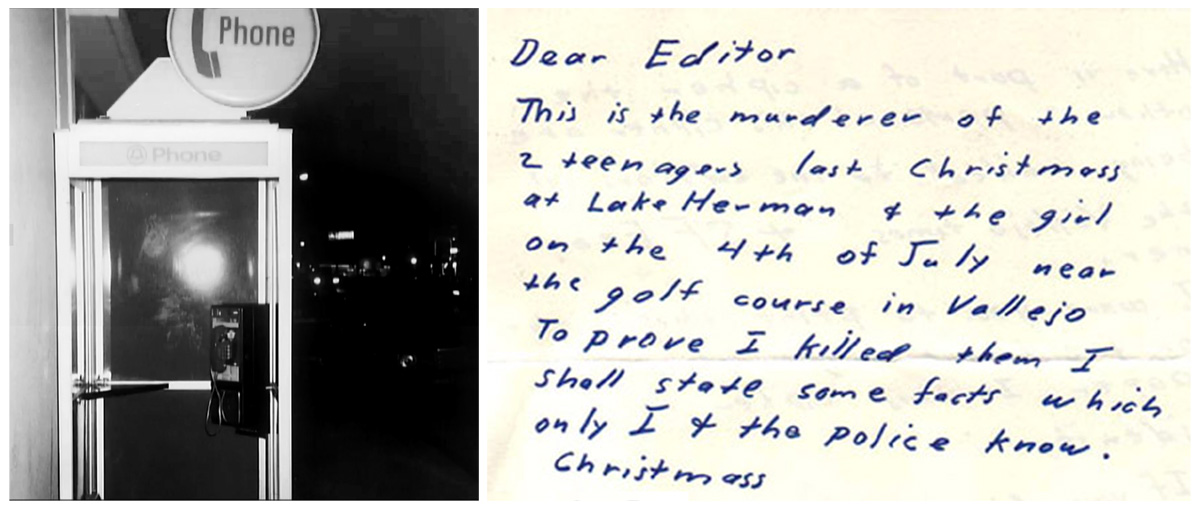
The Zodiac claimed that he was responsible for the shooting at Blue Rock Springs Park and the bizarre phone call to police on the night of the crime. Later rumors suggested that the killer had also placed several hang-up calls to members of Darlene’s family shortly after the shooting, but Darlene’s brother Leo reportedly admitted that he made these calls in his efforts to locate Darlene that night.

Payphone used by the Zodiac Vallejo.jpg

Detective Ed Rust interviewed Michael Mageau as he recovered in the hospital. His report read:

(Reporting Officer) questioned Michael as to a possible motive, if he had had any arguments or trouble, etc. with anyone recently, or if there was any reason at all that anyone would want to harm him. He stated he could not recall anything at all, having any arguments or anything to give anyone reason to do anything like this. Also states that Darlene did not say anything about any trouble that she has had. States they have always been very truthful with each other and confided very closely in each other’s problems and he is sure if she had known about someone after her or had a hate for her enough to do something like this, she would have said something about it. States as far as he knows, the only type of trouble that Dea has had was sometimes her friends got mad at her. There [were] sometimes petty jealousies between her and her friends. Sometimes some possibly boyfriends, not exactly dating type boyfriends, but friends, just acquaintances, would become jealous over just petty things.

Darlene’s friends, the members of her family, her co-workers and others were interviewed, but no one provided any information which indicated that anyone had any reason to harm either Darlene or Michael Mageau. Darlene’s sister Pam was unable to name any viable suspects and she knew of no reason for anyone to harm Darlene. Darlene’s sister Linda was also unable to identify or recall anyone with reason to harm Darlene, but she did provide the names of three of her sister’s best friends, including a man named Lee who used to bring her presents from Mexico. Police identified only one man said to have bothered Darlene. George was a frequent customer in the restaurant where Darlene worked and he apparently made unwanted advances toward her on several occasions. Investigators interviewed George and saw no reason to suspect that he had killed Darlene. Even Darlene’s ex-husband became a suspect after her family told several stories which appeared to implicate the man. Police eventually excluded the ex-husband as a suspect.

This turn of events marked the beginning of a pattern, a cloud which would follow the case for decades to come. The murder of Darlene Ferrin remained unsolved, and speculation grew regarding the possible motives behind the crime and those involved. Despite the evidence which indicated that Darlene and Michael had been the victims of a random attack, some people preferred to believe that she was the deliberate target of an orchestrated conspiracy to silence her for unknown reasons.

Darlene’s mother spoke with Christopher Harris, the West Coast Representative of the famous psychic Joseph Delouise. According to Harris, the woman claimed that Darlene had said that she would be in the newspapers the day after she was killed. Harris and Vallejo Mayor Florence Douglas appeared at a press conference at the Statler Hilton Hotel in Los Angeles. Douglas was a candidate struggling to win the Democratic nomination in the Governor’s race against incumbent Ronald Reagan. “I believe some clues were overlooked in the murder of Darlene Ferrin,” Douglas told reporters. She denounced the Vallejo police investigation and called for a new examination of the case. Harris complained that police were unwilling to listen to the new claims from Darlene’s family. “I observed while in Vallejo that the police disregarded the ridiculous,” he said. “I am now a firm believer that in the ridiculous, especially in the case of Darlene Ferrin, lies a storehouse of clues. The police should have done a complete character sketch of Darlene Ferrin. There are too many questions into her death that have not been properly tied down.”

Police had investigated virtually every single scrap of information they had received, including tips and stories from Darlene’s family, yet no one had mentioned the new claims when they had been interviewed many times before. Some members of Darlene’s family began to tell strange stories which indicated that Darlene may have known the killer and had witnesses a murder. These stories circulated and evolved over time to include stories of a mysterious yet unidentified stranger who had stalked Darlene in the weeks and months before her death. By the mid-1970s, Darlene’s sisters, Pam and Linda, were telling a very different story, one that became the popular myth which still dominates the public perception of this case today.

According to Pam, Darlene warned that she had witnessed a murder and that the murderer had been following her. Pam suspected that Darlene may have been involved in a satanic cult. Both Pam and Linda claimed they had attended a painting party in Darlene’s home, and that they had seen an unidentified man who arrived wearing a suit. Darlene was reportedly afraid of this man and warned Pam to stay away from him because, “She said he was a bad man… She’d seen him kill somebody.” Soon, others said that they had been at the party, too, including Vallejo police officer Steve Baldino, who also claimed that he had heard a recording of the Zodiac’s phone to call police on the night Darlene was killed. The story of the painting party expanded over time and eventually became a key component of many theories. When asked about this party, Dean Ferrin said no such party had ever taken place in his home and that he had painted the entire house by himself. Former Vallejo police dispatcher Nancy Slover spoke to the Zodiac on the night of the shooting and adamantly denied that any recording of the call had ever been made. According to Slover, the police department did not possess recording equipment in July 1969.

Neither Pam nor Linda ever mentioned any of these stories, or the mysterious and murderous stranger, when interviewed by police, and authorities quickly determined that Darlene’s sisters were not reliable or credible witnesses. A report written by VPD Detective Jack Mulanax, dated August 18, 1969, stated that Darlene’s sister Pam appeared to be “influenced” by the “power of suggestion.” Many other investigators would later describe Pam as an attention seeker prone to prevarication. Dean Ferrin refuted all of Pam’s stories, as have many others, including Dean’s cousin, Sue Ayers. For many years, Pam told people that Sue Ayers had visited Michael Mageau as he recovered in the hospital and that he confessed that he and Darlene were followed to the scene of the crime and the killer called Darlene by name just before the shooting began. This story also evolved over time to include an argument at Darlene’s place of work that night and another argument with the killer at Blue Rock Springs Park. In March 2007, I spoke with Sue Ayers and she refuted the entire story told by Pam.

Pam and Linda also offered conflicting descriptions and information concerning the unidentified stalker they claimed to have seen on several occasions. Despite the fact that she had originally described the man named “Lee” as one of Darlene’s friends, she later suggested that he could have been the stalker. Robert Graysmith used Linda’s original statements about Darlene’s friend Lee to connect the victim with his suspect Arthur Leigh Allen. Graysmith would later claimed that Leigh had known Darlene and all of the other Zodiac victims. Graysmith then used the stories about the chase to Blue Rock Springs Park, the stalker, the story of the painting party, Baldino’s claim of a Zodiac recording, and many more myths in his best-selling book ZODIAC, which later inspired the feature film of the same name.

Pam told various reporters that she was also the subject of harassment and stalking by one or more men. She claimed that someone had left a message on her home indicating the police code for murder, that someone had left a burning cross on her front lawn and a coffin at her front door. She also claimed that someone had written “Pam Dies” on the walls inside her house and even knocked her unconscious in order to steal a collection of documents she was about to give to television producers. Pam appeared on The Sally Jessy Raphael Show and claimed that Darlene had known Zodiac victim Betty Lou Jensen and had possibly witnessed her death and even the murder of suspected Zodiac victim Cheri Jo Bates. Pam also appeared on the Geraldo Rivera tabloid television program NOW IT CAN BE TOLD in segments which were produced by satanic conspiracy theorist Maury Terry. Pam confronted a bewildered Mageau, who said his memory had faded over time. Pam persisted, pointing her finger in Mageau’s face and repeating, “I know you know who did it!” The show linked Darlene’s murder to cult activity as part of the theory that she had been the deliberate target of an orchestrated conspiracy to silence her before she revealed some shocking and terrible truth about the crimes she had witnessed. Pam also told her stories during interviews for other television tabloid shows such as HARD COPY and A CURRENT AFFAIR.

Pam sister of Darlene Ferrin.jpg

The stories regarding the life and death of Darlene Ferrin invaded virtually every news report about the case and inspired more stories and theories about the stalker, satanic cults, the painting party, and other unstoppable myths. Linda later identified suspect Larry Kane as the mysterious stranger and Pam implicated various people over the years. The legends spread and the sensational spotlight attracted others who were eager to create more confusion and myths. Don Cheney, the man who had originally accused Arthur Leigh Allen, claimed that Allen’s brother and sister-in-law had been at the painting party with the suspect, and that Allen had worn a suit. Blaine Blaine, the man who originally accused Richard Gaikowski, claimed that his suspect had been arrested after an altercation with Darlene. Deborah Perez claimed that her father was the Zodiac and had known Darlene. Connecting Darlene Ferrin to a suspect was standard practice for any budding Zodiac theorist or opportunist.

In 1991, retired Vallejo police detective George Bawart met with Mageau and displayed an array of six suspect photographs. According to Vallejo police Lt. (and later Capt.) Joann West, Mageau initially pointed to a photograph of suspect Arthur Leigh Allen and said, “That’s him.” However, when asked if he was sure, Mageau then said that he was “pretty sure” and then pointed to the photograph of a different suspect and said that the shooter had a round face like that individual rather than Allen. Mageau then said Allen was the man who had shot him and assessed his own level at certainty on a scale of 1 to 10 as an 8. Allen did not match the original description of the shooter as provided by Mageau in the hours, days and weeks after the shooting in 1969.

Mageau was interviewed for the documentaries which accompanied the DVD release of the feature film ZODIAC, based on the books by Robert Graysmith. Michael Mageau told a story which contradicted his previous accounts yet was now in keeping in with the popular myths rather than the facts. According to Mageau’s new version, he and Darlene were followed to Blue Rock Springs Park, and Darlene indicated that she knew the shooter. Mageau claimed that the man was named “Richard,” and that this murderous stranger would kill them if he knew that Darlene was with Mageau. In this interview, Mageau said that the stranger’s car resembled a Cadillac. In 1969, he said that the car resembled Darlene’s Corvair. The two automobiles do not appear at all similar. During the same interview, Mageau expressed his hope that police would someday identify and capture the Zodiac. Mageau had apparently forgotten that he had “positively identified” the Zodiac more than 15 years earlier, and that the man he had identified (Allen) had been dead since 1991.

Michael Mageau 2007.jpg

After forty-one years, I believe that the investigation and study of the Darlene Ferrin murder, and the Zodiac case itself, has been contaminated and derailed by the many myths which have emerged over the years. The evidence strongly indicates that the gunman had selected them at random, that Darlene did not know the killer, and that the details of her life will not further the investigation in search of the Zodiac’s identity. Darlene Ferrin, like the other Zodiac victims, was simply in the wrong place at the right time. Michael Mageau’s statements to police and others in 1969 clearly indicate that the many stories which developed in the years that followed are not credible or accurate. Like so many unsolved mysteries, the murder of Darlene Ferrin generated rumors, rampant speculation, and a legend which continue to cloud the truth. Various message boards and websites feature sensational theories linking Darlene Ferrin’s death to countless conspirators, cult killers, sinister strangers, bizarre plots, and more, and some amateur sleuths keep the myths alive with new accusations, new suspects, and new stories which only serve to further victimize and exploit the dead.

The theories linking Darlene to the Zodiac distract from the facts, providing a far more entertaining and titillating version of history while burying reality in a maze of fiction. Had the Zodiac intended to create confusion in order to avoid detection, he could not have invented a better plan, or a more enduring diversion.